
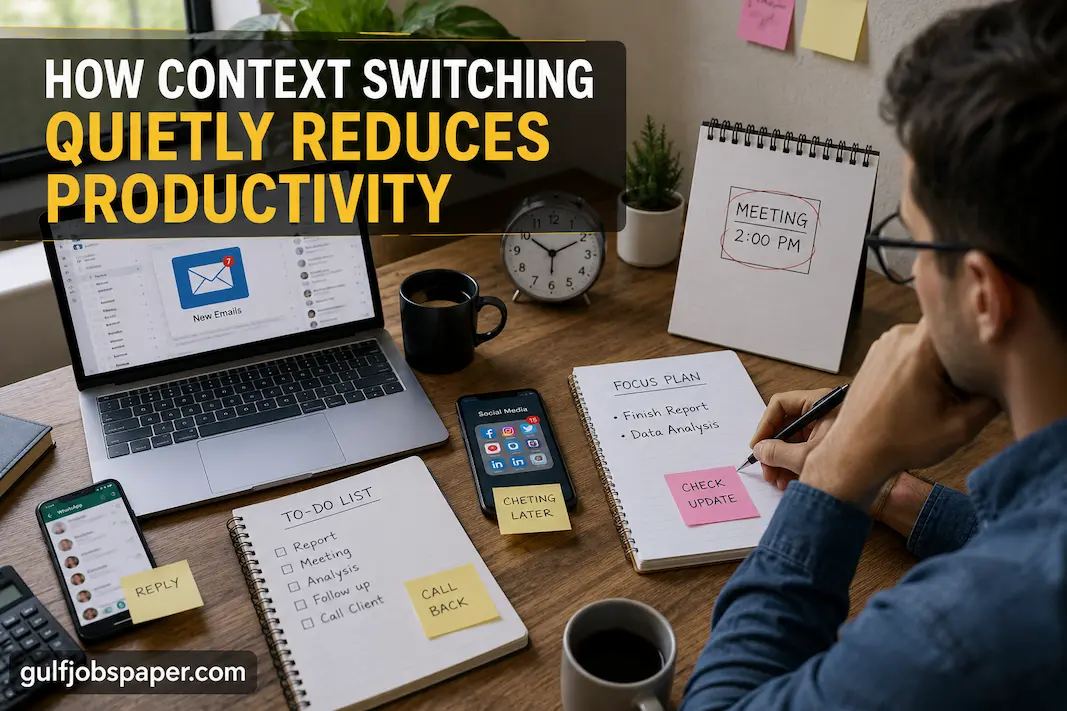
You finally find your rhythm after spending twenty minutes working through a difficult task. Ideas begin connecting naturally, decisions become easier, and progress feels steady. Then a notification appears. You quickly reply to a message, check an email that seems urgent, glance at your calendar, and answer a short phone call. None of these interruptions takes very long, yet when you return to your original work, something has changed. The flow has disappeared, and it takes several minutes just to remember exactly where you left off.
Many people assume productivity is lost only when they stop working altogether. In reality, some of the biggest reductions in efficiency happen while we’re still busy. The problem isn’t always inactivity—it’s the constant movement between unrelated tasks. Each switch forces the brain to leave one way of thinking behind and quickly adopt another, often before the previous task has been mentally completed.
This habit has become increasingly common in modern work. Emails arrive continuously, messaging apps demand attention, meetings interrupt focused work, and digital devices make switching between activities almost effortless. Although each interruption may seem small, their combined effect can quietly reduce concentration, increase mental fatigue, and make important work take far longer than expected.
Productivity Depends on Momentum, Not Just Time
Imagine two people each working for four hours.
The first spends most of that time focused on one meaningful project with only a few planned breaks. The second also works for four hours but constantly alternates between spreadsheets, emails, phone calls, messaging apps, meetings, and web browsing. Both have worked the same number of hours, yet their experience—and often their results—are completely different.
The difference lies in mental momentum.
When your attention remains on one task long enough, your brain gradually builds familiarity with the problem you’re solving. Details become easier to remember, connections appear more naturally, and decision-making often becomes faster. This deeper level of concentration doesn’t happen immediately; it develops over time.
Frequent interruptions repeatedly reset that process. Instead of building momentum, the brain keeps returning to the starting point, making every task feel as though it’s taking longer than it should.
Every Task Leaves Part of Your Attention Behind
One reason context switching feels so exhausting is that our minds rarely move cleanly from one activity to another. Even after closing a document or ending a conversation, part of our attention often remains connected to what we were just doing.
Think about replying to an important email before returning to a report. Although the email may be finished, your mind may continue considering the reply you sent or wondering whether another response will arrive. Similarly, leaving a meeting doesn’t instantly erase everything discussed. Those thoughts often remain active while you’re trying to concentrate on something completely different.
This lingering attention makes transitions more demanding than they appear. Instead of beginning each new task with a completely clear mind, you’re carrying pieces of previous conversations, unfinished ideas, and pending decisions into your next activity.
The result is subtle but important. Your attention becomes divided, making it harder to fully engage with whatever you’re currently trying to accomplish.
The Real Cost Comes After the Interruption
Most interruptions are surprisingly short. Checking a notification may take less than a minute. Answering a quick question from a colleague or family member might last only a few moments. Because these interruptions seem brief, we often assume they’ve had very little effect on our productivity.
The larger cost usually appears afterward.
Returning to a task often involves rereading previous work, remembering unfinished ideas, reviewing notes, or mentally rebuilding the path you were following before the interruption occurred. Creative work, analytical thinking, and problem-solving are particularly sensitive to these restarts because they depend on maintaining a continuous train of thought.
For example, a writer interrupted halfway through an article may spend several additional minutes rediscovering the tone and direction of the piece. Someone analyzing financial data may need to review multiple figures before confidently continuing their calculations. A programmer may reread sections of code simply to understand where they left off.
None of this extra effort is visible on a schedule, yet it quietly consumes valuable working time throughout the day.
The Small Interruptions We Stop Noticing
Not every context switch feels dramatic. In fact, the ones that happen most often are usually so familiar that they no longer attract attention.
Opening a browser to look up one fact before checking the news. Glancing at your phone while waiting for a file to load. Switching to email every few minutes just in case something important has arrived. Looking at workplace chat applications without receiving a notification. These behaviors often last only seconds, but they repeatedly interrupt the brain’s ability to stay engaged with one type of thinking.
Working from home introduces additional examples. You may pause to receive a delivery, answer a family member’s question, move laundry between machines, or quickly tidy part of the house before returning to work. Each interruption appears harmless on its own, yet together they create a workday filled with constant mental transitions.
Because these interruptions become routine, many people underestimate how frequently they’re switching attention. Recognizing these hidden patterns is often the first step toward improving concentration.
Group Similar Work Instead of Constantly Changing Direction
One practical way to reduce context switching is to organize similar types of work together. Rather than moving back and forth between unrelated tasks throughout the day, allow your mind to stay in one mode of thinking for longer periods.
For example, if you’re writing reports, articles, or proposals, complete as much writing as possible before turning your attention to email. If you need to review documents, schedule that work together instead of interrupting creative projects every few minutes. Administrative tasks, planning sessions, and meetings can also be grouped so they don’t repeatedly interrupt periods of focused concentration.
This approach isn’t about following a rigid schedule. It’s about reducing the number of times your brain has to completely change direction. The fewer mental transitions you make, the easier it becomes to maintain momentum and produce thoughtful, high-quality work.
Many professionals notice that difficult tasks become less intimidating simply because they remain engaged long enough to fully understand the problem before moving on to something else.
Try a Daily Context Switching Audit
Most people underestimate how often they interrupt themselves during the day. Spending just a few minutes reviewing your work habits can reveal patterns that usually go unnoticed.
Instead of counting every interruption, focus on the situations where you changed tasks without actually intending to.
| Context Switch | Was It Necessary? | Better Alternative |
|---|---|---|
| Checking email while writing | No | Finish the current section before reviewing email |
| Looking at phone notifications | Usually not | Keep the phone out of reach during focused work |
| Switching between multiple browser tabs | Sometimes | Close tabs unrelated to the current project |
| Responding instantly to every message | Not always | Check messages at planned intervals |
| Starting a new task before finishing another | Rarely | Complete one priority before beginning the next |
After a few days, you’ll often discover that many interruptions aren’t caused by other people—they’re habits you’ve gradually developed yourself. Recognizing these patterns makes it much easier to change them.
Signs You’re Switching Context Too Often
Frequent context switching doesn’t always feel dramatic. More often, it creates a constant sense of being busy without making meaningful progress.
One common sign is repeatedly forgetting where you left off after even brief interruptions. You may find yourself rereading the same document several times or reviewing notes simply to remember your previous thought process.
Another indicator is struggling to complete important tasks despite spending most of the day working. Your calendar appears full, your to-do list keeps changing, and you’re constantly occupied, yet major projects seem to move forward very slowly.
Mental fatigue is another clue. Constantly changing focus requires your brain to repeatedly adjust, make new decisions, and rebuild concentration. By the afternoon, you may feel unusually tired even though much of your work involved sitting at a desk.
Some people also notice increasing frustration with complex projects. Deep thinking becomes more difficult because every interruption breaks the momentum needed to solve challenging problems or develop creative ideas.
Common Habits That Increase Context Switching
Many interruptions begin with good intentions. Wanting to stay informed, respond quickly, or remain available for others seems productive, but these habits often create more disruption than expected.
Keeping email open throughout the day is one example. Every incoming message creates the temptation to stop what you’re doing, even if the information isn’t immediately important. Similarly, leaving messaging applications visible on your screen encourages frequent attention shifts that interrupt longer periods of concentration.
Another common habit is trying to multitask during meetings or phone calls. Answering emails while listening to a discussion often reduces the quality of both activities, leading to mistakes or the need to repeat work later.
Digital browsing also contributes to unnecessary switching. Opening one webpage to find information can easily turn into checking headlines, reading unrelated articles, or visiting social media before returning to the original task.
Reducing these habits doesn’t mean becoming unavailable or ignoring responsibilities. It simply means giving important work enough uninterrupted time before moving your attention elsewhere.
Frequently Asked Questions
Is context switching the same as multitasking?
They’re closely related but not identical. Multitasking often means attempting to handle several activities at once, while context switching refers to repeatedly moving your attention from one task to another. In practice, frequent multitasking usually results in constant context switching.
Is every interruption harmful?
No. Some interruptions are necessary and unavoidable, especially when collaborating with colleagues or responding to urgent situations. The goal isn’t to eliminate every interruption but to reduce the unnecessary ones that repeatedly break your concentration.
How can I reduce context switching without changing my entire schedule?
Start with one or two simple changes. Finish a writing task before checking email, silence non-essential notifications during focused work, or group similar activities together. Small adjustments often create noticeable improvements without requiring major changes to your routine.
Conclusion
Context switching rarely feels dramatic in the moment. A quick message here, a brief email there, and a short glance at your phone all seem harmless on their own. Yet these frequent mental transitions quietly interrupt concentration, slow decision-making, and make meaningful work take far longer than necessary. The greatest loss isn’t the few minutes spent on each interruption—it’s the time required to rebuild focus every time your attention changes direction.
Protecting your productivity isn’t about working longer hours or forcing yourself to concentrate harder. It’s about creating opportunities for uninterrupted thinking, grouping similar tasks together, and becoming more aware of the habits that repeatedly divide your attention. When your mind is allowed to remain engaged with one important task long enough to build momentum, work often becomes not only more productive but also more satisfying and less mentally exhausting.