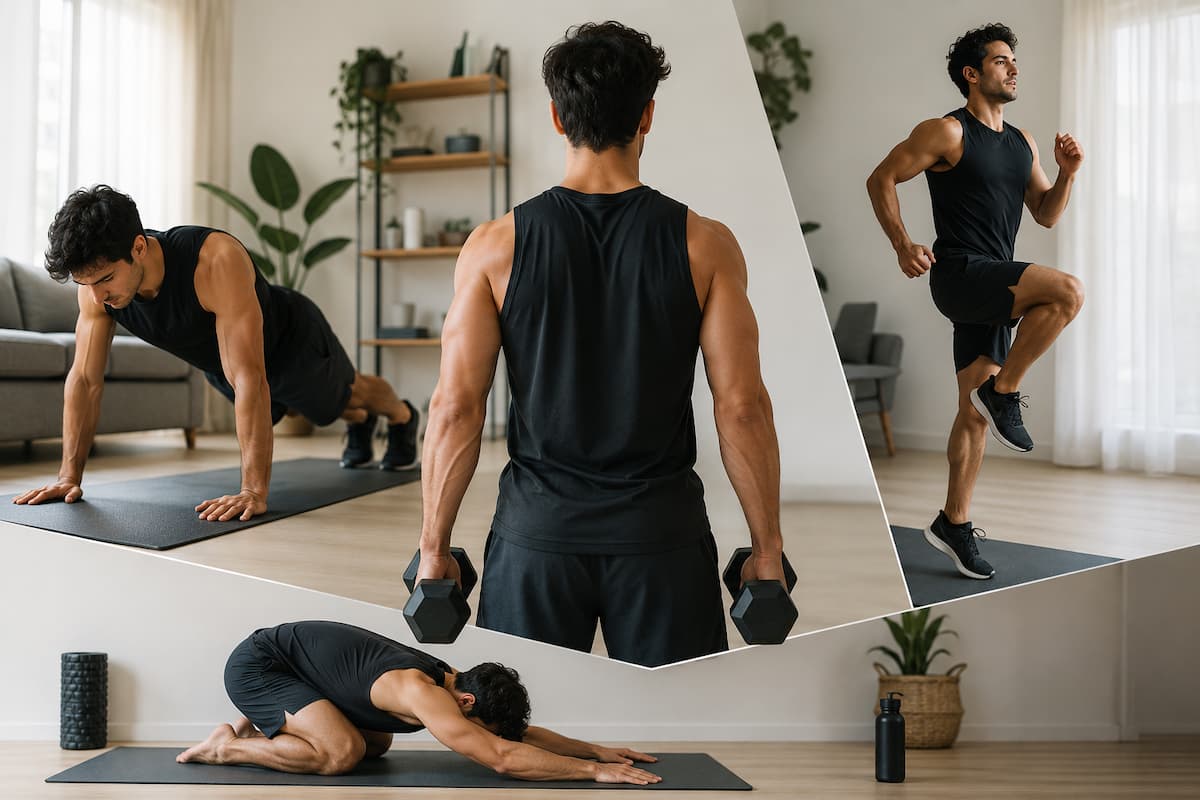
My Living Room Became My Gym (And Yours Can Too)
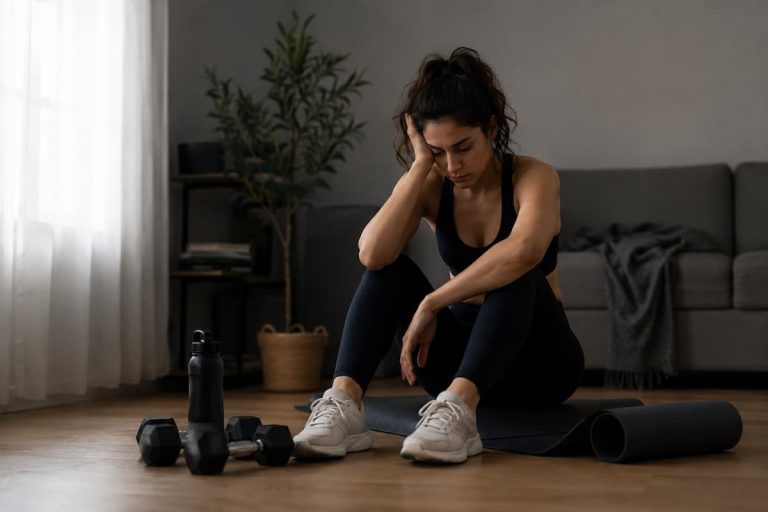
I canceled my gym membership in January of last year. Not because I had a better plan. Not because I discovered some revolutionary fitness secret. I canceled it because I was paying seventy dollars a month to feel guilty about not going. The gym was twenty minutes away, crowded after work, and full of people who seemed to know exactly what they were doing. I did not.
For three months, I did nothing. My fitness routine became nonexistent. I gained weight, lost energy, and started avoiding mirrors. Then one morning, I watched a video of a man in his sixties doing pistol squats in a studio apartment smaller than mine. No equipment. No space. Just consistent effort and smart programming. That was the moment I realized the problem was not my circumstances. It was my assumption that effective training required a facility.
What I built over the next year was not a replacement for the gym. It was something better. A program that combined strength, cardio, and mobility into three sessions per week, using nothing but my bodyweight and a few cheap items I already owned. I got stronger, leaner, and more flexible than I had ever been with a gym membership. This guide is exactly what I did, why it worked, and how you can start this week without spending a dollar.
Why Most Home Workouts Fail
Before building something that worked, I had to understand why my previous attempts failed. The YouTube videos were random. One day I would do a twenty-minute HIIT session. The next day, a yoga flow. The day after, some random ab circuit. There was no progression, no balance, and no plan. My body had no reason to adapt because the stimulus kept changing without increasing.
Effective training requires three elements. Progressive overload means gradually increasing the challenge. Specificity means training for what you actually want. Recovery means giving your body time to rebuild. Most home workouts ignore all three. They are designed to make you sweat, not to make you stronger.
The other failure mode was equipment envy. I believed I needed a squat rack, dumbbells, a bench, and a pull-up bar to build real strength. Those things help, but they are not required. The human body is a remarkably effective training tool when you know how to use it. Push-ups, squats, lunges, planks, and rows can be modified to challenge a complete beginner or an advanced athlete. The difference is not the equipment. It is the understanding of leverage, tempo, and progression.
What I Learned First: A push-up is not just a push-up. Elevate your hands and it becomes easier. Elevate your feet and it becomes harder. Slow the descent to five seconds and the intensity changes completely. The same exercise can train a beginner or challenge an advanced lifter with simple adjustments. Bodyweight training is not limited. It is misunderstood.
Building the Three-Pillar System
My program needed to address three distinct physical qualities without requiring separate sessions for each. Strength for muscle and bone density. Cardio for heart health and endurance. Mobility for injury prevention and movement quality. Most programs focus on one and ignore the others. I wanted integration.
The solution was a full-body circuit performed three times per week, with each session lasting forty to fifty minutes. The structure remained consistent. The exercises progressed over time. The intensity adjusted based on how I felt that day. This consistency made it sustainable. The progression made it effective.
| Pillar | Primary Exercises | How It Integrates | Progression Method |
|---|---|---|---|
| Strength | Push-ups, squats, rows, glute bridges | Compound movements build functional muscle using bodyweight resistance | Decrease leverage, add tempo, increase reps, then difficulty |
| Cardio | Burpees, mountain climbers, jump squats, high knees | Short bursts between strength sets keep heart rate elevated | Increase work intervals, decrease rest, add rounds |
| Mobility | Hip openers, thoracic rotations, ankle circles, shoulder dislocates | Embedded as warm-up and cool-down, not separate sessions | Increase range of motion, hold positions longer, add complexity |
Each session followed the same template. A ten-minute mobility warm-up. Twenty-five minutes of strength and cardio circuits. A five-minute mobility cool-down. The consistency made it easy to start. I never had to decide what to do. I just had to show up and follow the plan.
The Exact Weekly Structure I Used
I trained Monday, Wednesday, and Friday. This gave me forty-eight hours between sessions for recovery, which was essential for strength adaptation. Tuesday and Thursday were active recovery days. I walked for thirty minutes, did some light stretching, and avoided anything intense. Weekends were completely free. No training, no guilt.
Session A focused on horizontal pushing and pulling, plus lower body. Push-ups, inverted rows using a table, squats, and glute bridges. Between each strength pair, I did twenty seconds of mountain climbers or burpees. The cardio was built into the strength work, not added at the end when I was already tired.
Session B focused on vertical pushing and pulling, plus single-leg work. Pike push-ups, doorframe rows, Bulgarian split squats using a chair, and single-leg Romanian deadlifts. The cardio intervals were jump squats and high knees. The structure was identical to Session A. Only the exercises changed.
Session C was a full-body conditioning day. All the exercises from A and B combined into longer circuits with shorter rest. This built work capacity and tested my progress. If I could complete Session C with better form than last week, I knew the program was working.
My Starting Point: On day one, I could do eight regular push-ups before my form broke down. I could not do a single inverted row. My squat depth was barely to parallel. I was not athletic. I was not strong. I was just consistent. That consistency is what built the results, not any natural advantage.
Progression Without Equipment
The biggest challenge of home training is increasing difficulty without adding weight. I solved this through a hierarchy of progression for each movement. First, increase repetitions. Once I could do three sets of fifteen with good form, I made the exercise harder. Then I built reps again.
For push-ups, the progression went like this. Standard push-ups to fifteen reps. Then elevate feet on a chair. Then diamond push-ups with hands close together. Then decline diamond push-ups. Each step felt like starting over, but that was the point. The challenge reset, and the adaptation began again.
For squats, I started with bodyweight squats to twenty reps. Then goblet squats holding a backpack filled with books. Then Bulgarian split squats. Then shrimp squats, which are essentially one-legged squats with the back leg held behind you. By month eight, I was doing pistol squats, a movement I once thought required a gym and years of training.
The key was patience. Most people rush to the hardest variation and compensate with bad form. I spent four weeks at each level, sometimes longer. Quality mattered more than speed. A perfect standard push-up is more valuable than a sloppy diamond push-up.
What I Actually Bought (And What I Did Not)
My total equipment investment was under thirty dollars. A jump rope for eight dollars. A set of resistance bands for fifteen dollars. Two yoga blocks for six dollars. That was it. Everything else used furniture, walls, and my own body.
The jump rope became my primary cardio tool on days when I wanted a quick session without the full circuit. Ten minutes of jumping rope is more demanding than most people expect. The resistance bands added pulling movements when I wanted variety beyond table rows. The yoga blocks helped with mobility work and certain squat progressions.
I did not buy a pull-up bar because I did not have a suitable doorway. I did not buy dumbbells because they were expensive and unnecessary for my goals. I did not buy a bench because my coffee table worked fine. The minimalist approach forced creativity, and creativity kept me engaged.
Equipment Truth: The best equipment is the equipment you will actually use. A thousand-dollar home gym that collects dust is worse than a jump rope you use daily. Start with nothing. Add only what solves a specific problem you have encountered. Most problems are solved with creativity, not purchases.
The Results After One Year
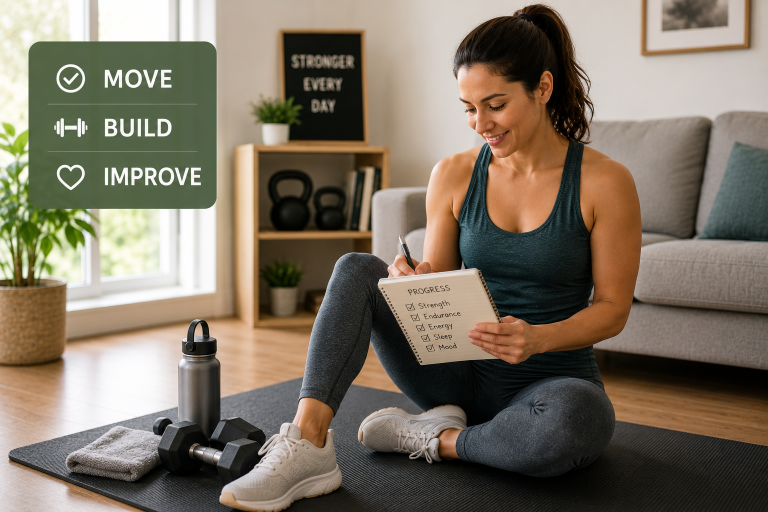
Numbers do not tell the whole story, but they help. I lost twenty-three pounds of fat and gained visible muscle definition in my chest, shoulders, and legs. My resting heart rate dropped from seventy-two to fifty-eight beats per minute. I could do twenty-five push-ups, five pistol squats per leg, and hold a plank for three minutes. More importantly, I felt capable. Daily tasks became easier. Stairs did not wind me. I carried groceries without strain.
The mobility improvements were unexpected. My hip flexibility increased dramatically. My lower back pain, which had plagued me for years, disappeared. The daily warm-up and cool-down movements, which I initially considered optional, turned out to be the most valuable part of the program. They fixed problems I did not know were fixable.
Psychologically, the change was even bigger. I no longer felt dependent on a facility to stay fit. I could train anywhere. Hotel rooms, parks, friends’ houses. The freedom was liberating. Fitness became part of my identity, not just my schedule.
What I Would Tell Myself on Day One
If I could go back, I would emphasize two things. First, consistency beats intensity. The best workout is the one you actually do. I missed maybe six sessions in twelve months. Not because I was disciplined. Because the program was simple enough that skipping felt harder than showing up.
Second, progress is not linear. Some weeks I felt weaker. Some weeks I plateaued. Those weeks were not failures. They were part of the process. The body adapts in bursts, not steady climbs. Trusting the process during flat periods was the hardest mental challenge and the most important skill I developed.
I would also tell myself to film my form. Early on, I thought my push-ups were perfect. Video revealed my hips sagging and my elbows flaring. Recording yourself is uncomfortable but invaluable. It exposes what you cannot feel.
Starting Your Own Home Training This Week
You do not need a plan. You need a session. Do something today. A ten-minute walk, twenty squats, and five push-ups from your knees. The first step is physical, not mental. Momentum builds from action, not contemplation.
Once you have done one session, build the habit. Three times per week, same days, same time. Morning works best for most people because willpower depletes throughout the day. But any time you will actually show up is the right time.
After four weeks of consistency, worry about progression. Increase reps. Add a harder variation. Shorten rest periods. The program will evolve naturally if you pay attention to what feels easy and what still challenges you.
Your living room is enough. Your body is enough. Your consistency is what matters. Everything else is just details.
Sources and References
- American College of Sports Medicine. (2024). ACSM’s Guidelines for Exercise Testing and Prescription (12th ed.). Wolters Kluwer.
- Overcoming Gravity: A Systematic Approach to Gymnastics and Bodyweight Strength. (2023). Progressive Bodyweight Training Methodology. Retrieved from https://www.eatmoveimprove.com/
- Journal of Strength and Conditioning Research. (2022). Effects of Bodyweight Training on Muscular Strength and Endurance. Retrieved from https://journals.lww.com/nsca-jscr/
- Harvard Health Publishing. (2024). The Science of Exercise: How Physical Activity Benefits the Body and Brain. Retrieved from https://www.health.harvard.edu/exercise-and-fitness
- Mayo Clinic. (2023). Bodyweight Exercises: How to Get Started. Retrieved from https://www.mayoclinic.org/healthy-lifestyle/fitness/in-depth/bodyweight-exercises/art-20447434
- Journal of Sports Medicine and Physical Fitness. (2023). Home-Based Exercise Programs and Adherence Rates. Retrieved from https://www.minervamedica.it/en/journals/sports-med-physical-fitness/